How to Draw a Life Map
A life map is a simple, visual way to look back on your life story — the people, events, turning points, and seasons that have shaped you. There's no right or wrong way to do this. Let your pen (or pencil, or markers) go where it wants.
What You'll Need
One sheet of paper
Pens, pencils, or markers
20–30 minutes of quiet time
Steps
1. Draw a line. Start by drawing a single line across your page. This line represents your life from birth (one end) to today (the other end). The shape of the line is up to you — let it rise and fall to reflect easier and harder periods.
2. Mark your milestones. Along the line, mark the moments that matter — births, deaths, moves, relationships, graduations, losses, achievements, illnesses, decisions, or anything else that shaped who you are. Use words, symbols, or small drawings — whatever feels natural.
3. Show the highs and lows. Let the line rise for good seasons and dip for hard ones. You don't need to explain everything in detail — just capture the general shape of each period.
4. Add color or symbols if you'd like. Some people like to use color to show emotion (e.g., dark colors for hard times, bright colors for joyful ones). This is optional — use whatever feels true to you.
5. Note the people who mattered. Around the line, you can add names of people who influenced you — for better or worse — at different points along the way.
6. Don't overthink it. This isn't an art project or a test. There's no "correct" way to draw a life. Include what feels important to you and skip what doesn't.
Sample Life Map: George Washington
Here's an example of how a life map might look, using the life of George Washington as a model. Notice how the line rises and falls with hardship and triumph, and how milestones are marked simply along the way.
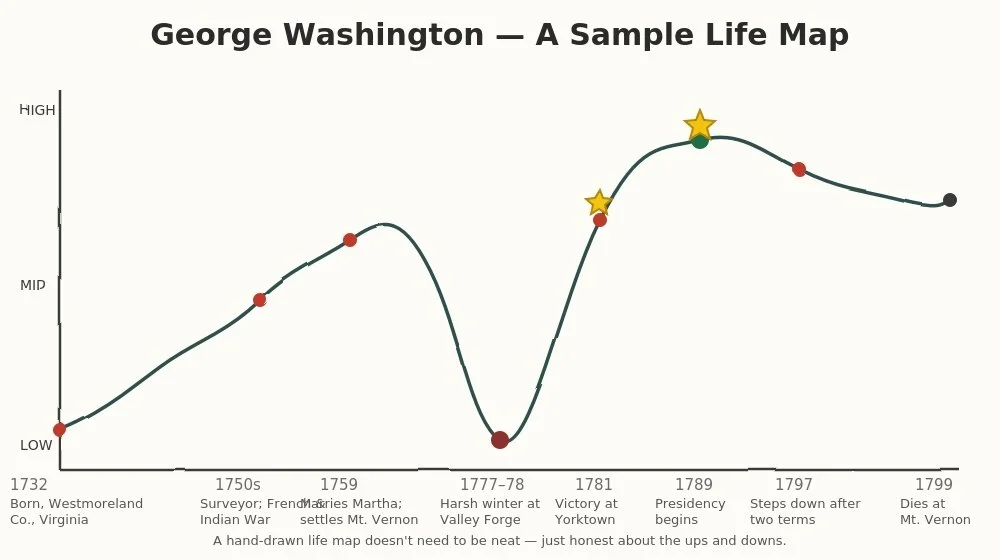
Key milestones marked on the map:
1732 — Born in Westmoreland County, Virginia
1750s — Works as a surveyor; serves in the French and Indian War (early hardship and loss of men under his command)
1759 — Marries Martha Dandridge Custis; settles at Mount Vernon
1775 — Appointed Commander of the Continental Army
1777–78 — The brutal winter at Valley Forge (a "low point" on the map — cold, disease, and doubt)
1781 — Victory at Yorktown, turning the tide of the Revolutionary War
1789 — Becomes the first U.S. President
1797 — Voluntarily steps down after two terms, setting a precedent for peaceful transfer of power
1799 — Dies at Mount Vernon
Notice how the map doesn't just list dates — it shows movement: the low point at Valley Forge, the rise into victory and the presidency, and a life that ends on a note of intentional closure. Your own map might have some very different-looking peaks and valleys, and that's exactly the point.
A Few Reflection Questions
Once you're done, you might look at your map and ask:
What patterns do I notice?
Which moments feel unfinished or still tender?
What season am I in right now?
What would I want the next chapter to look like?
How does my relationship with God impact my line?
Be sure to run through these reflection questions for each core structure in your life:
Marriage
Family
Work/Career
Faith/Religion
Social/Friends
Civic/Community
Health
Financial
Bring your map to your next session if you'd like to talk through it together.